

Five Psychological Barriers to Meaning Lucidity

© 2026. Luis A. Marrero. Boston Institute for Meaningful Purpose
"It's sobering to think that you and I can know about a social process that distorts our thinking and still be susceptible to it." David G. Myers, PhD

Early in my journey toward developing Meaningful Purpose Psychology, I discovered a central obstacle to a meaningful life: the illusion that we already understand. This insight resonated deeply with my training and practice in Transactional Analysis (Berne, 1961, 1964), which revealed how people can unknowingly operate from hidden psychological scripts, ulterior transactions, and "games" that sabotage their behavior, relationships, and results.
Years later, I found a similar theme in Robert Marshak's work on covert processes (Marshak, 2006), which demonstrated that hidden assumptions, unspoken agendas, and unconscious dynamics can quietly undermine organizational effectiveness. These perspectives reinforced my conviction that beneath many human problems lie meanings that remain unexamined and therefore continue to shape behavior outside conscious awareness.
Fortunately, I was also able to build a solution to deal with the illusion that comes from a paradox, “The Cassandra Effect,” The solution starts with Meaning Lucidity.
Meaningful Purpose Psychology proposes that flourishing begins with Meaning Lucidity—the capacity to perceive ourselves, others, and reality with greater accuracy. Yet decades of research in cognitive and social psychology demonstrate that human beings are naturally prone to systematic biases that distort perception, protect existing beliefs, and resist corrective evidence (Festinger, 1957; Kahneman, 2011; Kunda, 1990; Nickerson, 1998). Meaning Lucidity, therefore, does not arise automatically; it requires the intentional examination and continual improvement of the meanings through which we interpret our experience.
Empirical science demonstrates that, instead of examining meanings, people often defend them.
Where cognitive psychology identifies the mental biases that distort judgment, Meaningful Purpose Psychology investigates how these and other meaning-defense mechanisms interfere with Meaning Lucidity by protecting unhealthy or inaccurate meanings. It also provides methods for recognizing, validating, and regenerating healthier meanings that promote wiser decisions and human flourishing. In that context, the following examples show several common psychological processes that keep people from seeing themselves and reality more clearly.
1. "I Knew It All Along."
After an event happens, many people convince themselves they predicted it all along. Psychologists call this hindsight bias. Research by Baruch Fischhoff demonstrated that once people know an outcome, they consistently overestimate how predictable it had been (Baruch, 1975).

People operating under hindsight bias often make statements such as, "I knew it all along," "I saw it coming," "I always knew that would happen," or "It was obvious from the beginning." Others may say, "This just confirms what I've always believed," "I wasn't surprised at all," or "I told you so."
In reality, these statements frequently reflect a reconstruction of memory after the fact rather than an accurate recollection of what was actually believed beforehand. Once we know an outcome, our minds tend to rewrite history, making past events seem more predictable and our previous judgments seem more accurate than they truly were. This illusion creates a dangerous consequence. If we believe we already know the answer, we never examine whether our original thinking was actually correct. There is little motivation to learn because the mind quietly rewrites history. In this way, hindsight bias becomes an obstacle to Meaning Lucidity, replacing genuine learning with the comforting illusion of certainty.
Meaning Lucidity begins by admitting: "Perhaps I didn't understand as well as I now believe."
2. "I Only Notice What Supports My Beliefs."
Perhaps the most studied obstacle to objective thinking is confirmation bias. Research by Peter Wason showed that people naturally search for evidence that confirms what they already believe, while overlooking contradictory information (Wason, 1960).
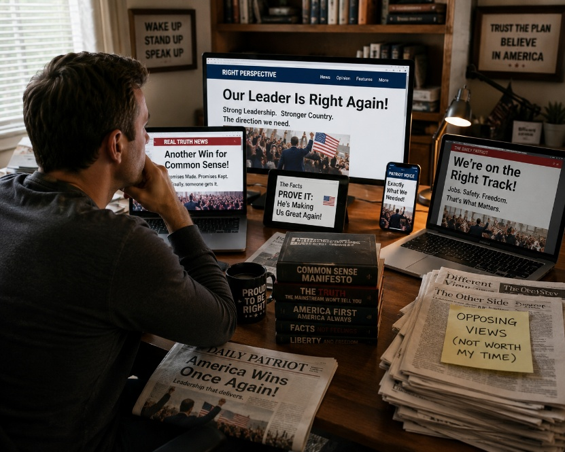
People seeking to confirm their existing beliefs often look for information that supports them, while ignoring or dismissing information that does not. They may say, "See? I told you I was right," "This article proves my point," "Everyone I know agrees with me," or "I don't need to hear the other side." They tend to follow news sources, social media accounts, or experts who reinforce what they already believe, while quickly discounting contradictory evidence as biased, uninformed, or irrelevant. Rather than asking, "What is true?" they unconsciously ask, "How can I prove that I'm right?" This pattern creates an echo chamber that strengthens existing meanings and makes it increasingly difficult to recognize alternative perspectives or revise one's conclusions.
From the perspective of Meaningful Purpose Psychology, confirmation bias is more than a thinking error. It is a defense of existing meanings. Every time we seek validation instead of understanding, we move farther from Meaning Lucidity and closer to the illusion that our current interpretation is beyond question. This pattern leads naturally to another obstacle: assuming our own perspective is exempt from bias.
Meaning Lucidity requires intentionally seeking evidence that challenges our assumptions.
3. "That Doesn't Apply to Me."
Many people believe they are less biased than everyone else. Ironically, psychologists call this the bias blind spot. Research by Emily Pronin found that individuals readily recognize biases in others while failing to detect the same biases in themselves (Pronin, 2007). This tendency shows up in everyday comments such as, "I'm just being objective," "Unlike them, I look at the facts," "They're letting their emotions get in the way," or "I don't have an agenda."
People readily identify prejudice, stubbornness, or selective thinking in others while assuming their own judgments are fair and impartial. The consequence is profound. The very people who most need self-examination often feel least in need of it, making genuine learning and Meaning Lucidity much more difficult to achieve.

Meaning Lucidity begins with intellectual humility. That humility matters because recognizing bias in others is not enough; we must also question our own certainty.
4. "Changing My Mind Would Mean I Was Wrong."
Sometimes the evidence is overwhelming, yet people still refuse to change. This phenomenon is explained by cognitive dissonance theory, introduced by Leon Festinger. When new evidence conflicts with deeply held beliefs, the resulting psychological discomfort motivates people to reduce the tension—not necessarily by accepting the truth—but by rationalizing, minimizing, or dismissing the evidence (Festinger, 1957).

This tendency often appears in statements such as, "Yes, but…," "That's just one study," "Those facts are taken out of context," "Everyone is entitled to their opinion," or "I still think I'm right." Others simply change the subject, move the goalposts, or insist that the evidence is biased. Rather than revising their beliefs, they reinterpret the evidence to protect their existing worldview. Protecting one's identity often becomes more important than discovering reality.
Meaning Lucidity requires valuing truth above ego. When that is difficult, the next obstacle often appears: the urge to protect identity by resisting change.
5. "Everyone Else Thinks the Same."
Humans are social beings. We naturally look to others to determine what is true. Classic conformity experiments conducted by Solomon Asch showed that people frequently deny the evidence of their own eyes simply because a group unanimously disagrees with them (Asch, 1951).
Our desire to belong can quietly replace independent thinking. When acceptance becomes more important than truth, distorted meanings spread throughout families, organizations, and entire societies.

Meaning Lucidity sometimes requires the courage to stand alone. This challenge becomes especially important when social pressure makes agreement feel safer than independent judgment.
The Common Thread
Although these five patterns appear different, they all serve the same psychological function: they protect existing meanings from being questioned. Ironically, the mind often works harder to defend its current interpretation than to discover whether that interpretation is actually true. This insight lies at the heart of Meaningful Purpose Psychology. Human flourishing depends not merely on possessing meanings but on continually improving their quality.
That process begins with Meaning Lucidity—the willingness to ask:
What if I am mistaken?
What evidence have I ignored?
What meanings am I protecting?
What would I believe if I were seeing this situation clearly?
These questions may be uncomfortable. Yet they open the door to wiser decisions, healthier relationships, and a more meaningful life.
Scientific Foundation
These five mechanisms are among the most extensively replicated findings in cognitive and social psychology:
Hindsight Bias — Baruch Fischhoff (1975)
Confirmation Bias — Peter Wason (1960)
Bias Blind Spot — Emily Pronin (2002)
Cognitive Dissonance — Leon Festinger (1957)
Conformity Effect — Solomon Asch (1951)
The Meaning Lucidity Challenge
Before you make an important decision this week, ask yourself:
What meaning am I assigning to this situation?
What evidence supports that meaning?
What evidence challenges it?
If a wise and impartial observer looked at this situation, what might they see that I don't?
Which interpretation is most likely to promote human flourishing—for me and for others?
Meaningful Purpose Psychology teaches that flourishing begins not with better intentions, but with clearer meanings. Every step toward Meaning Lucidity is a step toward a wiser, healthier, and more meaningful life.
To Learn More
Join one of our developmental programs. Visit our website to learn more about ways to strengthen your life’s meaning.
Or contact us for a customized solution at: https://www.bostonimp.com/service-page/free-consultation
References (APA 7th Edition)
Asch, S. E. (1951). Effects of group pressure upon the modification and distortion of judgments. In H. Guetzkow (Ed.), Groups, leadership, and men (pp. 177–190). Carnegie Press.
Baruch Fischhoff, B. (1975). Hindsight ≠ foresight: The effect of outcome knowledge on judgment under uncertainty. Journal of Experimental Psychology: Human Perception and Performance, 1(3), 288–299.
Berne, E. (1961). Transactional analysis in psychotherapy: A systematic individual and social psychiatry. Grove Press.
Berne, E. (1964). Games people play: The psychology of human relationships. Grove Press.
Festinger, L. (1957). A theory of cognitive dissonance. Stanford University Press.
Fischhoff, B. (1975). Hindsight ≠ foresight: The effect of outcome knowledge on judgment under uncertainty. Journal of Experimental Psychology: Human Perception and Performance, 1(3), 288–299. https://doi.org/10.1037/0096-1523.1.3.288
Daniel Kahneman, D. (2011). Thinking, fast and slow. Farrar, Straus and Giroux.
Emily Pronin, E., Lin, D. Y., & Ross, L. (2002). The bias blind spot: Perceptions of bias in self versus others. Personality and Social Psychology Bulletin, 28(3), 369–381.
Fischhoff, B. (2025). Fifty years of hindsight bias research: Reflection on Fischhoff (1975). American Psychologist.
Leon Festinger, L. (1957). A theory of cognitive dissonance. Stanford University Press.
Marshak, R. J. (2006). Covert processes at work: Managing the five hidden dimensions of organizational change. Berrett-Koehler Publishers.
Nickerson, R. S. (1998). Confirmation bias: A ubiquitous phenomenon in many guises. Review of General Psychology, 2(2), 175–220. https://doi.org/10.1037/1089-2680.2.2.175
Pronin, E., Lin, D. Y., & Ross, L. (2002). The bias blind spot: Perceptions of bias in self versus others. Personality and Social Psychology Bulletin, 28(3), 369–381. https://doi.org/10.1177/0146167202286008
Pronin, E. (2007). Perception and misperception of bias in human judgment. Trends in Cognitive Sciences, 11(1), 37–43. https://doi.org/10.1016/j.tics.2006.11.001
Wason, P. C. (1960). On the failure to eliminate hypotheses in a conceptual task. Quarterly Journal of Experimental Psychology, 12(3), 129–140. https://doi.org/10.1080/17470216008416717
Ziva Kunda, Z. (1990). The case for motivated reasoning. Psychological Bulletin, 108(3), 480–498.



Comments