

Why Knowledge Isn’t Enough: What Neuroscience Explains—and What It Leaves Out

(Why the World Is the Way It Is — Part 2)
© 2026 Luis A. Marrero. Boston Institute for Meaningful Purpose
[Text written with, by, and for human intelligence.]

We live in an era of unmatched knowledge. Never before have we learned so much about the brain, behavior, and human decision-making. Fields like neuroscience and behavioral psychology have uncovered how habits form, how motivation functions, and why people often act against their own intentions. Yet, despite this surge of knowledge, many of the world’s most persistent problems still exist. People and nations continue to engage in behaviors they know are harmful.
Organizations make the same mistakes over and over. Societies face ongoing issues with polarization, inequality, and conflict. This raises a crucial question: If we understand so much about how humans think and act, why do so many problems endure?
What Neuroscience Gets Right

Neuroscience has made remarkable contributions to our understanding of human behavior. Research shows that behavior is driven not just by knowledge but by a combination of:
• automatic processes
• habits
• reinforcement systems
• social and environmental influences
The work of Daniel Kahneman demonstrates that much of human behavior is controlled by fast, automatic thinking rather than deliberate reasoning (Kahneman, 2011).
Similarly, research on habits reveals that a large part of our daily actions are performed automatically, often without conscious thought (Wood, 2019).
These findings confirm something many people already sense:
People often know what is right but fail to act accordingly.
The Knowledge–Behavior Gap

This phenomenon is widely recognized in behavioral science as the knowledge–behavior gap. In simple terms: knowing isn't the same as doing. A person may know that:
• healthy habits improve well-being
• collaboration leads to better outcomes
• long-term thinking results in better decisions
Yet, they still act in ways that contradict that knowledge.
Neuroscience explains why this happens. Habits are strengthened through repetition. Behavior is shaped by immediate rewards.
Social environments influence what feels acceptable or necessary. But this raises a deeper question.
What Is Still Missing?
If neuroscience explains how behavior works, what explains why people choose one course of action over another? Why do individuals and societies adopt certain patterns of behavior in the first place?
To answer that question, we need to look beyond the neuroscience mechanism.
We need to explore meaning.
Meaning as the Missing Layer
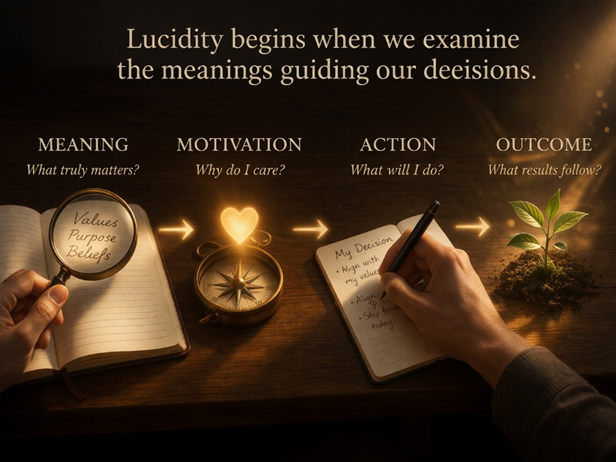
Psychiatrist Viktor Frankl defined meaning simply as “what is meant.”
In logoteleology, meaning can be more precisely understood as: an aim supported by causes, where those causes are triggered by an interpretation of reality.
In other words, people do not act solely based on knowledge. They act based on the meanings they assign to reality.
These meanings shape:
• what they believe to be true
• the principles that guide their behavior
• what they value most
• what they seek to accomplish
And ultimately, meaning determines people's actions and results.
When Knowledge Encounters Distorted Meaning

This insight helps explain why knowledge alone often fails to bring about change.
A person may understand something intellectually, yet still operate under meanings that are:
incomplete
inaccurate
or distorted
These distorted meanings—what I refer to as dysmeaning—can arise from:
ignorance
incomplete information
incorrect or corrupted information
When dysmeaning is present, behavior follows the distorted interpretation—not the correct knowledge.
For example:
A leader may understand the importance of collaboration but operate under the belief that others cannot be trusted.
An organization may promote innovation while maintaining a culture that punishes failure.
A society may advocate fairness while holding assumptions that divide people into categories of greater or lesser worth.
In each case, knowledge exists—but meaning governs behavior.
Where Neuroscience and Meaning Meet
This isn't a criticism of neuroscience; actually, it strengthens this view.
Neuroscience research also demonstrates that the brain can change through experience—a trait known as neuroplasticity (Doidge, 2007)—and that repeated behaviors are encoded as habits in neural circuits (Graybiel, 2008).
Neuroscience explains how:
habits develop
behavior is reinforced
energy is drawn for action
environments affect decisions
But it does not determine what:
is true
is right
is worth pursuing
These are questions about meaning.
This leads to an important insight:
Neuroscience explains how behavior works. Meaning guides how that neuroscientific machinery is used.
Why This Matters for Today’s World
We live in an era where knowledge is plentiful. Information is easily available. Science continues to advance. Technology keeps accelerating. Yet, many of the same human challenges remain.
From a logoteleological perspective, this isn’t a failure of knowledge. It’s a failure of meaning. When meanings are distorted—by bias, incomplete information, or false assumptions—actions are influenced by those distortions, even if accurate knowledge exists. This explains why progress in knowledge doesn’t automatically lead to better human outcomes.
Toward Meaning Lucidity

If meaning influences behavior, then improving the quality of that meaning becomes crucial. This involves developing meaning lucidity: the ability to analyze interpretations and match them with reality, free from biases, prejudices, blind spots, and denial.
Meaning clarity enables individuals to:
• question their assumptions
• refine their beliefs
• align their principles
• clarify their priorities
• pursue more meaningful goals
Over time, this results in better decisions—and improved outcomes.
A Practical Next Step
Understanding these ideas intellectually is only the beginning. The true challenge lies in learning how to examine and refine the meanings that guide your decisions in daily life—especially when you're under pressure, facing uncertainty, or dealing with competing demands.
For those interested in exploring further, I offer a Meaning of Life Laboratory during the summer—an interactive experience designed to help you apply meaning analysis to your own life, relationships, and future direction. Because insight alone is not enough. Transformation requires practice.

What about you? What meanings are guiding your life?
Our Next Article
In the next article, we will explore how the Meaning Construct—the set of elements that shape interpretation and behavior—can help explain why individuals and societies become increasingly polarized.
References
Doidge, N. (2007). The brain that changes itself: Stories of personal triumph from the frontiers of brain science. Viking.
Frankl, V. E. (2006). Man’s search for meaning. Beacon Press. (Original work published 1959)
Graybiel, A. M. (2008). Habits, rituals, and the evaluative brain. Annual Review of Neuroscience, 31, 359–387. https://doi.org/10.1146/annurev.neuro.29.051605.112851
Kahneman, D. (2011). Thinking, fast and slow. Farrar, Straus and Giroux.
LeDoux, J. (2012). Rethinking the emotional brain. Neuron, 73(4), 653–676. https://doi.org/10.1016/j.neuron.2012.02.004
Wood, W. (2019). Good habits, bad habits: The science of making positive changes that stick. Farrar, Straus and Giroux.


Comments