

Organizations as Systems of Work and Systems of Meaning

A Framework for Sustainable Organizational Flourishing
© 2026. Luis A. Marrero, M.A., RODP. Boston Institute for Meaningful Purpose

Abstract
Industrial-Organizational (I/O) Psychology has contributed substantially to the understanding and improvement of workplace effectiveness, leadership, employee well-being, organizational culture, team performance, and organizational change. Through decades of research and practice, the field has generated valuable insights into how organizations can create conditions that support both effectiveness and employee success.
Meaningful Purpose Psychology (Logoteleology) contributes a complementary perspective by examining the meanings through which individuals, groups, and organizations interpret themselves, others, their work, and reality. It proposes that meaning serves as an important interpretive and motivational foundation influencing behavior, decision-making, culture, leadership, and organizational life.
This paper explores how Industrial-Organizational Psychology and Meaningful Purpose Psychology may jointly contribute to understanding organizational flourishing. While I/O Psychology offers sophisticated methods for designing and improving organizational systems, Meaningful Purpose Psychology focuses on the quality, lucidity, and sustainability of the meanings that operate within those systems. Together, these perspectives offer a more comprehensive framework for understanding how organizations can achieve enduring effectiveness, well-being, and human flourishing.
Introduction
Organizations today possess access to an unprecedented body of knowledge concerning human behavior, leadership, motivation, organizational effectiveness, and workplace well-being.
Industrial-Organizational Psychology has played a significant role in generating this knowledge. Its contributions have helped organizations improve employee selection, leadership effectiveness, team functioning, organizational culture, employee engagement, and organizational development.
At the same time, researchers and practitioners continue exploring important questions regarding sustainable human flourishing. Why do some organizations maintain healthy cultures while others struggle to do so? Why do some improvements endure while others gradually erode? Why do individuals and organizations sometimes persist in patterns that undermine their own aspirations despite possessing substantial knowledge and resources?
Meaningful Purpose Psychology emerged from an interest in understanding these questions by studying meaning. Specifically, it examines how meanings shape perception, motivation, identity, relationships, decision-making, and purposeful action.
The premise of this paper is simple: Organizations are simultaneous systems of activity and systems of meaning.
People do not merely respond to structures, policies, incentives, and leadership practices. They also respond to what those structures, policies, incentives, and leadership practices mean. Consequently, a more complete understanding of organizational flourishing may emerge when both organizational systems and meaning systems are examined together.
This paper explores how Industrial-Organizational Psychology and Meaningful Purpose Psychology may contribute complementary insights toward that shared objective.
The Contributions of Industrial-Organizational Psychology
Industrial-Organizational Psychology has made substantial contributions to understanding work and organizations.
Major areas of contribution include:
Personnel selection
Leadership development
Motivation
Team effectiveness
Organizational culture
Employee engagement
Job design
Performance management
Organizational development
Employee well-being
Change management

These contributions have improved both organizational effectiveness and employee experience. The discipline has demonstrated that organizational outcomes can be influenced through deliberate design of systems, structures, processes, leadership practices, and workplace conditions. As a result, organizations today possess significantly more knowledge about effective management than at any previous point in history.
The Persistence of Organizational Challenges
Despite these advances, significant challenges remain. Employee disengagement remains widespread. Organizational change efforts continue to experience high failure rates. Leadership failures remain common. Burnout continues to affect employees across industries. Many organizations struggle to sustain cultural transformation over time.
These realities raise an important question:
If interventions continue improving, why do many organizational problems remain persistent?
Meaningful Purpose Psychology proposes that the answer may involve a deeper layer of organizational functioning.
Meaning as a Foundational Organizational Variable
Meaningful Purpose Psychology begins with a simple proposition:
Meaning sets the agenda.
Human beings do not respond directly to reality. They respond to the meanings they assign to reality.
Consequently:
Motivation follows meaning.
Behavior follows meaning.
Leadership follows meaning.
Culture reflects shared meanings.
Systems embody meanings.

Human beings do not respond directly to reality. They respond to the meanings they assign to reality.
Every organizational process is ultimately interpreted through meaning. Employees do not merely react to policies. They react to what those policies mean. Employees do not merely experience leadership. They interpret what leadership means. Employees do not merely participate in culture. They construct meaning from what the culture communicates about value, identity, fairness, contribution, and belonging.
Dysmeaning and Organizational Dysfunction
Meaningful Purpose Psychology introduces the concept of dysmeaning.
Dysmeanings are low-quality meanings that impair flourishing. Examples may
include:
People are valuable only when productive.
Mistakes must be hidden.
Speaking up is dangerous.
Power determines truth.
Survival matters more than integrity.

Such meanings may become embedded within individuals, teams, leadership systems, and organizational cultures. Importantly, dysmeanings frequently remain invisible. They often appear normal, rational, or necessary to those who hold them.
The Organizational Logoteleology Sleeper Effect
One of Meaningful Purpose Psychology's most distinctive propositions is the Logoteleology Sleeper Effect.
Organizations often contain dormant dysmeanings that remain inactive during stable periods. Under stress, however, these latent meanings become activated.
Examples include:
Economic downturns
Leadership transitions
Organizational restructuring
Mergers and acquisitions
Public crises
A culture may appear healthy for years. Then a crisis emerges. Suddenly, trust deteriorates. Collaboration declines. Fear increases. Blame emerges. The crisis did not necessarily create these dynamics. It may have revealed dysmeanings that were already present.
The Logoteleology Sleeper Effect suggests that organizations often contain hidden meaning structures whose influence remains largely invisible until they are activated by changing conditions.
The Organizational Sisyphus Effect
A second phenomenon concerns sustainability. Organizations often experience cycles of improvement followed by regression. Culture initiatives succeed temporarily. Leadership programs produce short-term gains. Engagement improves and then declines. Meaningful Purpose Psychology refers to this pattern as the Logoteleology Sisyphus Effect.
The explanation is straightforward.
Organizations often improve behavior without sufficiently altering the meanings that produce it. As long as dysmeanings remain intact, they retain the capacity to reassert themselves. Consequently, organizations may repeatedly address the same underlying problems.
Organizations often improve behavior without sufficiently altering the meanings that produce it. As long as dysmeanings remain intact, they retain the capacity to reassert themselves.
Meaning Regeneration™ as a Complement to Organizational Intervention
Meaningful Purpose Psychology proposes Meaning Regeneration™ as a process for addressing this challenge.
Meaning Regeneration™ involves:
Identifying operating meanings
Examining meaning antecedents
Detecting dysmeanings
Increasing meaning lucidity™
Replacing impaired meanings with healthier alternatives
Reinforcing meaningful interpretations and actions
Rather than replacing traditional organizational interventions, Meaning Regeneration™ seeks to strengthen them. It addresses the interpretive layer through which organizational practices are experienced.
Complementary Strengths
Industrial-Organizational Psychology and Meaningful Purpose Psychology address different but highly compatible questions.
Industrial-Organizational Psychology asks:
How do we improve organizational effectiveness?
Meaningful Purpose Psychology asks:
What meanings are shaping organizational effectiveness?
Industrial-Organizational Psychology studies:
Performance
Leadership
Motivation
Culture
Teams
Systems
Meaningful Purpose Psychology studies:
Meaning quality
Meaning lucidity™
Meaning antecedents
Dysmeaning
Meaning regeneration™
Shared meaning systems
One focuses primarily on organizational functioning. The other focuses primarily on the meanings that govern organizational functioning. Together, they offer a more complete understanding of organizational life.
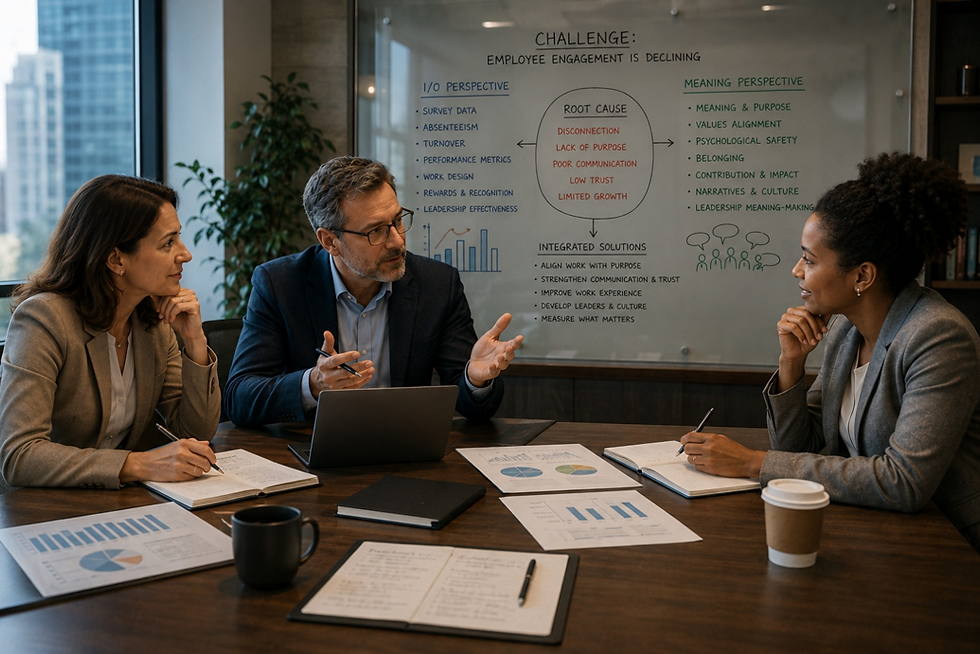
Toward Meaning-Governed Organizations
A potential future direction for organizational science involves integrating system design with meaning governance.
Organizations routinely manage:
Finances
Operations
Strategy
Technology
Risk
Yet few organizations systematically examine the quality of the meanings that operate within their cultures. Meaning governance would involve ongoing attention to:
Shared assumptions
Organizational narratives
Identity structures
Interpretive frameworks
Meaning quality
Meaning lucidity™
Such efforts may help organizations identify emerging dysmeanings before they become embedded within systems and cultures.
Conclusion
Industrial-Organizational Psychology has provided powerful tools for understanding and improving organizational effectiveness.
Meaningful Purpose Psychology proposes that these efforts can be strengthened by examining the meanings that shape organizational behavior, leadership, culture, and decision-making.
The two disciplines represent complementary levels of inquiry.
Industrial-Organizational Psychology helps organizations design effective systems.
Meaningful Purpose Psychology helps organizations examine the meanings operating within those systems.
Together, they offer the possibility of moving beyond temporary improvement toward more enduring human and organizational flourishing. If sustainable flourishing requires both healthy systems and healthy meanings, then the future of organizational development may lie in integrating them.
Become Part of the Solution

For Industrial-Organizational Psychologists
Industrial-Organizational Psychology has made extraordinary contributions to our understanding of work, leadership, motivation, engagement, organizational culture, employee well-being, and organizational effectiveness.
Yet many challenges continue to persist.
Organizations invest in leadership development, engagement initiatives, culture change efforts, performance management systems, and organizational redesigns. Improvements often occur. Yet many organizations eventually find themselves revisiting familiar problems:
Declining engagement
Resistance to change
Cultural deterioration
Leadership failures
Dysfunctional team dynamics
Erosion of trust
Misalignment between values and behavior
Why?
Meaningful Purpose Psychology (Logoteleology) emerged from a question that may be relevant to every helping profession:
If evidence-based solutions exist, why do individuals, teams, and organizations so often struggle to sustain meaningful progress?
Meaningful Purpose Psychology proposes that part of the answer may lie in the meanings people attach to themselves, others, their work, and reality.
While I/O Psychology helps us understand and improve organizational systems, Meaningful Purpose Psychology examines the quality of the meanings operating within those systems.
Organizations are not merely systems of work. They are also systems of meaning.
Meaningful Purpose Practitioner Program – Module One
Module One introduces participants to a framework for understanding how meaning influences:
Motivation
Identity
Leadership
Culture
Decision-making
Employee experience
Organizational flourishing
Participants will explore concepts such as:
Meaning Constructs
Meaning Quality
Meaning Lucidity™
Dysmeaning
The Logoteleology Sleeper Effect
Meaning Regeneration™
The program also introduces practical methods for examining how hidden assumptions, interpretations, values, attitudes, and aims may influence organizational outcomes.
Why This May Interest I/O Psychologists
This program may be particularly valuable for professionals interested in:
Employee engagement
Organizational culture
Leadership effectiveness
Organizational development
Psychological safety
Change management
Human flourishing at work
Meaningful Purpose Psychology does not seek to replace existing organizational approaches.
Rather, it offers an additional perspective for understanding why some interventions thrive, some fail, and some produce results that prove difficult to sustain.
Join the Conversation
If you are interested in exploring how meaning influences organizational life...
If you are curious about the relationship between organizational systems and meaning systems...
If you wish to expand your ability to help individuals, teams, and organizations flourish...
We invite you to join us.
Become part of a growing community of practitioners dedicated to understanding and advancing sustainable human flourishing.
Become a Certified Meaningful Purpose Practitioner.
Your journey begins with Module One.
Learn more and apply here:


Comments